Home
» Tips
»
Printable One-Page Marketing Strategy Template for Local Businesses
Printable One-Page Marketing Strategy Template for Local Businesses
A local marketing strategy does not need to be a 30-page document to be useful. For many owner-operated businesses, the better working format is a single page that forces a few decisions: who you are trying to reach, what you want them to do, why they should choose you, which channels deserve attention, how much you can spend, and how you will know whether the plan is working.
The tradeoff is important. A one-page plan is fast to review and easy to keep visible, but it cannot hold every campaign detail, keyword, creative variation, or financial assumption. Treat it as a decision sheet, not a substitute for your calendar, ad account, customer list, or bookkeeping. The U.S. Small Business Administration recommends covering target market, competitive advantage, goals, action plan, and budget in a marketing plan, then measuring costs against results over time. That structure is a strong fit for a printable one-page format. See the SBA marketing and sales guidance.
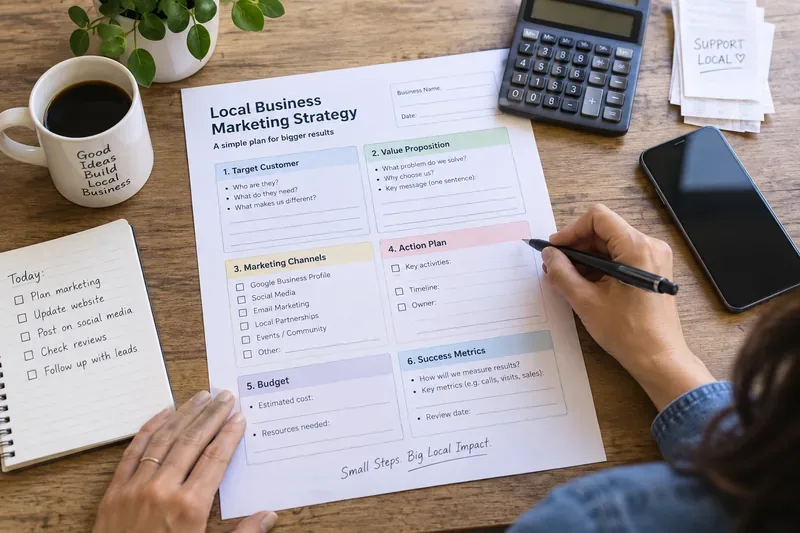
A local business owner fills out a one-page marketing strategy worksheet while reviewing channels, budget, actions, and success metrics.
Printable one-page marketing strategy template
Use the worksheet below for a 30-, 60-, or 90-day planning period. The goal is not to fill every blank with marketing jargon. The goal is to make choices you can execute with the time, money, and staff you actually have.
Choose one primary outcome: more qualified calls, appointments, store visits, first purchases, repeat purchases, memberships, or another measurable result. Target: ____________________
2. Target customer and service area
Customer: ____________________ Location or radius: ____________________ Buying trigger or need: ____________________
3. Offer and competitive advantage
What are you offering now? ____________________ Why should this customer choose you instead of an alternative? ____________________
4. Primary acquisition channel
Channel: ____________________ Why it fits the customer and goal: ____________________
Which marketing channel should get the most attention?
There is no universal answer. The right choice depends on customer intent, how local your service area is, how quickly you need demand, whether you already have an audience, and how much tracking discipline you can maintain. A practical one-page strategy usually works better when one channel has a clear primary job and the other channels support it, rather than when a small business tries to post, advertise, email, print, sponsor, and network everywhere at once.
Channel
Strong fit when
Main advantage
Main tradeoff
Useful measurement
Google Business Profile and local search
People already search for your type of business nearby and you meet customers in person
High relevance to local discovery on Search and Maps
Requires accurate information, reviews, photos, and ongoing profile maintenance; online-only businesses may not be eligible
Calls, direction requests, website visits, bookings, local leads
Paid search or local ads
You need demand now and customers actively search for the service
Can target geographic areas and search intent
Costs can rise with competition, and poor targeting or landing pages can waste budget
Cost per qualified lead, booked job, sale, call quality
Organic social media
Your product is visual, community-driven, event-based, or benefits from frequent updates
Good for showing personality, proof, new products, and community participation
Requires steady content production and can be harder to attribute directly to revenue
Choose Google Business Profile when local discovery is central
As checked in September 2026, Google says a business generally must make in-person contact with customers during its stated hours to qualify for a Business Profile. Eligible businesses can add or claim a profile at no charge and manage how business information appears on Google Search and Maps. That makes the profile especially relevant to storefronts and service-area businesses, but it is not a fit for every online-only operation. Review the current Google Business Profile eligibility guidelines and Google instructions for adding or claiming a profile.
Use it when: customers compare nearby providers, need directions, want hours, or check reviews before contacting you. Tradeoff: the profile is not a complete marketing system. You still need a clear offer, strong customer experience, accurate business information, and a way to convert discovery into a call, visit, booking, or sale.
Choose paid local search when speed and intent matter more than low cost
Google Ads currently supports targeting by countries, areas within a country, radius, and some location groups, with availability varying by country. Google also warns that very small geographic targets may show only intermittently. For a plumber, dentist, attorney, repair service, or other business where customers often search with immediate intent, that geographic control can be valuable. See Google's location targeting instructions.
Use it when: a new lead has meaningful value, you can answer quickly, and you have a landing page or call process that converts. Tradeoff: paid search buys opportunities, not guaranteed customers. Put a budget cap and a lead-quality metric on the one-page plan so you can stop or change a campaign before spend drifts away from the business goal.
Choose email when retention is more important than constant acquisition
Email is often more useful after a customer has already shown interest. A salon may use it for appointment reminders and seasonal offers; a retailer may use it for launches; a service business may use it for maintenance reminders. The limitation is simple: email does little for a business with no useful list, and compliance matters.
For U.S. commercial email, the FTC's CAN-SPAM guidance requires accurate sender information and subject lines, a valid physical postal address, a clear opt-out method, and honoring opt-out requests within 10 business days, among other requirements. The law applies to commercial messages, including many business-to-business messages. Review the FTC CAN-SPAM compliance guide. Businesses outside the United States should check the rules that apply in their jurisdiction rather than assuming U.S. requirements are sufficient.
Choose direct mail when geography is easier to define than a digital audience
For U.S. businesses, USPS Every Door Direct Mail is one option for reaching selected carrier routes without needing individual names and street addresses. The USPS tool can be used to select neighborhoods and filter routes with demographic information such as age, household size, and income. EDDM Retail also has current volume rules and mailpiece requirements, so confirm them before printing. See the official USPS EDDM page.
Use it when: a restaurant, clinic, home-service company, store, or local event needs broad neighborhood coverage. Tradeoff: every mailed piece has a real production and distribution cost, so pair the campaign with a trackable offer, dedicated landing page, QR code, phone extension, or coupon code. If you cannot tell which response came from the mailing, the channel becomes harder to compare fairly against paid search or email.
How should a local business divide its budget?
Start with the business constraint, not a generic percentage. A business with abundant staff time but little cash may lean toward profile optimization, community partnerships, and organic content. A business with limited time but strong customer value may prefer tightly tracked paid search. A neighborhood restaurant may accept printing costs because physical proximity is the audience definition. A boutique with a loyal customer list may put more effort into email and launches than into broad acquisition.
The one-page template therefore uses a budget cap instead of a recommended marketing percentage. Your cap should include more than media spend. Count printing, software, contractor fees, promotional discounts, and staff time when they are material. The SBA specifically recommends including a complete breakdown of marketing-plan costs and continuing to track those costs after launch. That prevents a channel that looks “free” from hiding a large labor burden.
Pick metrics that match the buying process
A local business can easily drown in impressions, followers, opens, and clicks that never become customers. Choose one primary KPI that sits as close as practical to the sale. A restaurant might track redeemed offers or orders. A home-service company might track qualified calls and booked jobs. A clinic might track booked appointments. A retailer might track store sales tied to a promotion. Supporting metrics can explain what happened, but they should not replace the business outcome.
Cost per qualified lead: marketing cost divided by leads that meet your qualification standard.
Cost per new customer: acquisition marketing cost divided by new customers attributed to the campaign.
Conversion rate: completed desired actions divided by the relevant visits, calls, or leads.
Repeat purchase or booking rate: the share of existing customers who return within the period you define.
Tracked promotion revenue: revenue tied to a specific code, campaign, landing page, or source when your systems support reliable attribution.
Do not force a precise ROI number when your attribution is weak. For channels such as local events, referrals, or word of mouth, it can be more honest to record known leads and sales plus a note about attribution limits. SBA guidance recognizes that some tactics, including print and word of mouth, are harder to measure and recommends consistency in how effectiveness is evaluated.
Recommended channel combinations by business need
For a new storefront that needs local awareness
Start with an accurate Google Business Profile if eligible, then choose either a neighborhood reach tactic such as direct mail or a community partnership. The benefit is geographic focus. The tradeoff is that awareness can rise before you have enough sales data to know which message is strongest, so use one offer and one tracking method during the test period.
For a service business that depends on urgent leads
Make local search visibility the foundation and consider paid search if the economics support it. The benefit is alignment with high-intent searches. The tradeoff is budget exposure: if calls are poorly qualified or unanswered, media spend will not fix the sales process. Track qualified calls and booked work, not just clicks.
For a retailer, café, salon, or studio with repeat customers
Use a discovery channel to attract first visits, then build a permission-appropriate retention channel such as email. The benefit is that you are not repeatedly paying or working from zero to reach the same satisfied customers. The tradeoff is operational discipline: the business has to capture customer information appropriately, send useful messages, and respect opt-outs.
For a professional business built on trust
Partnerships, referrals, educational events, local search, and a strong website may be more important than frequent promotional posting. The benefit is credibility. The tradeoff is slower attribution and less predictable volume. Add a simple “How did you hear about us?” field to intake and review referral sources monthly.
What should stay off the one-page plan?
Keep the strategy page focused on decisions. Detailed keyword lists, social post calendars, ad creative, email copy, full customer personas, vendor quotes, and transaction-level performance data belong in supporting documents or tools. If the page becomes dense enough that nobody reviews it, it has stopped doing its job.
A one-page strategy is also not permanent. The SBA notes that marketing strategies should evolve as business needs change and recommends maintaining the marketing plan at least annually. For a short operating plan, a monthly or campaign-end review is often more useful because it lets you compare the target with actual leads, customers, revenue, and cost while the details are still fresh.
Final check before you print
Can you name one primary customer group without saying “everyone”?
Is the service area specific enough to guide channel targeting?
Does the offer give the customer a clear reason to act?
Does each channel have a job instead of simply being listed?
Is there a hard budget cap or time limit?
Can the primary KPI be measured with your current phone, booking, POS, CRM, or website setup?
Is there a review date and a clear keep/change/stop decision?
If you can answer those questions on one sheet, you have a useful operating strategy. The value of the template is not that it predicts the perfect channel. It makes the tradeoffs visible, gives every marketing activity a reason to exist, and creates a simple point of comparison when you review what actually happened.